

Are you passionate about understanding climate and environmental change?
Join the Paleoclimate & Water Lab!
Launching at the University of Tennessee, Knoxville in January 2027. We care deeply about careful science, meaningful collaboration, and respectful mentorship. Our work brings together field, laboratory, and computational methods to understand how climate variability shapes water and ecosystems across timescales.
Where could your research take you?
Conduct fieldwork

Develop lab skills

Code and
model
Collaborate


Share your science
Teach and mentor
Potential research areas
I am interested in working with students on projects related to one or more of the following areas:
🌏 Tropical hydroclimate and environmental change from sediments and soils
🌏 Climate, water, ecosystems, fire, and societies
🌏 Monsoon dynamics, isotope-enabled modeling, and proxy-model integration
🌏 Calibration and development for paleoclimate proxies
Current openings
🚨Graduate opportunities for Fall 2027
I am recruiting graduate students to begin in Fall 2027. Students from geology, environmental science, ecology, geochemistry, climate science, data science, and related fields are encouraged to apply.
Prior experience with coding, lab methods, GIS, or fieldwork is helpful, but no applicant is expected to arrive with every skill. I value curiosity, reliability, careful work, and a willingness to learn.
Funding: Admission offers include tuition coverage, health insurance, and a monthly stipend.
Application deadline: 1 January 2027
To introduce yourself,
email jsaelim@utk.edu with
-
A brief introduction
-
Your research interests
-
Relevant experience
-
Why you are interested in the lab
-
Your CV or resume
⛔ Postdoctoral researchers
There are no open postdoctoral positions at this time. Prospective applicant seeking external fellowship support are welcome to contact Nadia to discuss potential alignment and sponsorship.
⛔ Undergraduate students
The Paleoclimate & Water Lab will launch in 2027. Undergraduate research opportunities will expand as the lab grows. More info about future projects will be posted here.
Potential graduate projects
01
#wetland
Wetland resilience and human adaptation
Investigate how monsoon variability, hydrologic change, and disturbance have shaped wetlands and societies in the lower Mekong Basin.
*We received a National Geographic Society grant for this work
02
#paleofire
Paleofire and environmental change
Reconstruct fire history in Mainland Southeast Asia and examine its relationships with hydroclimate, vegetation, sea-level change, and human activities
Project directions will be refined around each student's interests, experiences, and career goals.
Why join us in Knoxville?
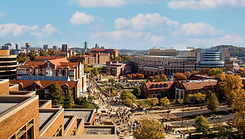
Photo: UTK
The University of Tennessee, Knoxville offers a collaborative research environment with strong connections across climate science, environmental research, geochemistry, ecology, and data-intensive modeling. UT’s longstanding partnership with Oak Ridge National Laboratory creates additional opportunities for interdisciplinary research, advanced computing, and scientific collaboration.

Photo: UTK EEPS
The Department of Earth, Environmental, and Planetary Sciences brings together researchers working across climate, geochemistry, hydrology, ecology, planetary science, and Earth system modeling. Its interdisciplinary structure supports collaboration across field, laboratory, computational, and data-driven research. Students benefit from a broad scientific community, shared analytical resources, and opportunities to connect their work with researchers across UT Knoxville and Oak Ridge National Laboratory.

Photo: UTK
UT Knoxville is committed to supporting students from a wide range of backgrounds, including first-generation college students. As a first-generation college student myself, I understand that academic expectations, professional networks, and many unwritten norms are not equally accessible to everyone. Our group is committed to transparent mentoring, clear expectations, and individualized support as students navigate research, graduate education, and future careers.

Photo: UTK
Knoxville combines the energy of a university city with easy access to rivers, forests, and mountains. The region experiences four distinct seasons, with warm summers, colorful autumns, and generally modest winter snowfall. The city offers extensive opportunities for hiking, biking, climbing, and paddling, including more than 60 miles of trails and greenways within Knoxville’s Urban Wilderness. Great Smoky Mountains National Park is about an hour away.